

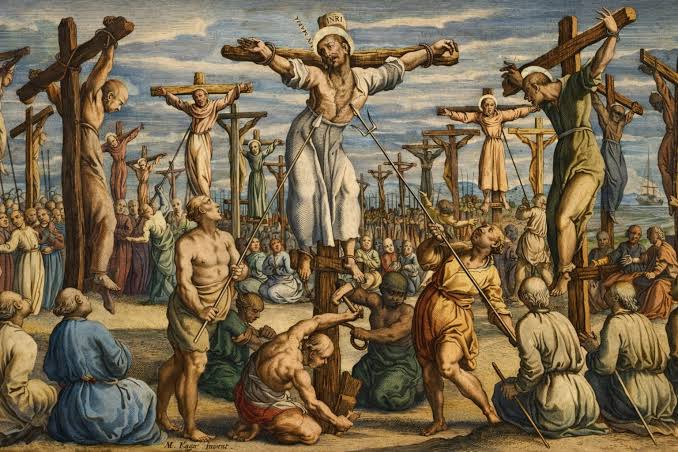
On 5 February 1597, twenty-six Christians were executed in Nagasaki, Japan.
Among them were priests, religious brothers, catechists and ordinary lay Christians. Some were Japanese. Others had come from outside Japan.
They were taken to a hill overlooking Nagasaki and crucified.
But their deaths did not end the story.
In the years that followed, Christianity in Japan would face increasingly severe persecution. Churches would disappear. Missionaries would be expelled. Christians would be forced to hide their faith.
And yet, something remarkable happened.
Christianity survived.
For more than two centuries, communities of Japanese Christians secretly passed their faith from one generation to another, even when there were no priests openly ministering among them.
The story of Japan’s 26 martyrs is therefore not only a story about death. It is also a story about what happened when a persecuted faith refused to disappear.
How Did Christianity Reach Japan?
Christianity arrived in Japan in the sixteenth century through Catholic missionaries.
One of the most important figures was the Jesuit missionary Francis Xavier, who arrived in Japan in 1549.
Over the following decades, missionaries preached throughout parts of the country, and Japanese people began converting to Christianity. Christian communities developed, particularly in areas such as Kyushu.
Nagasaki eventually became an important centre of Japanese Christianity.
For a period, Christianity grew considerably. Japanese converts included people from different social backgrounds, including powerful figures and ordinary citizens.
But the political situation changed.
READ ALSO: He Was a Slave Trader Before He Became a Christian. Then He Wrote “Amazing Grace”
Why Did Japan Begin Persecuting Christians?
The history is more complicated than simply saying that Japan suddenly decided it hated Christianity.
Christianity had arrived alongside growing European commercial and political influence. Japanese rulers were also concerned about foreign missionaries, competing religious influences and the possibility that religious allegiance could affect political loyalty.
As political leaders became increasingly suspicious of Christianity, restrictions began to grow.
In 1587, Toyotomi Hideyoshi issued an order restricting missionary activity. The situation became increasingly dangerous.
Then came a decisive moment in 1597.
The 26 Christians Who Were Sent to Their Death
In late 1596, a group of Christians came under suspicion after a Spanish ship, the San Felipe, was confiscated in Japan.
Among those arrested were missionaries and Japanese Christians.
Twenty-six people were eventually condemned.
They were forced to travel hundreds of kilometres from Kyoto toward Nagasaki. During the journey, according to historical accounts, the prisoners were publicly displayed and suffered humiliation as they were taken toward their place of execution.
When they reached Nagasaki, they were taken to Nishizaka Hill.
There, on 5 February 1597, all twenty-six were crucified.
The Vatican identifies the group as the first major group of Christian martyrs in Japan and records their canonization by Pope Pius IX in 1862.
Who Were These 26 Christians?
One of the things that makes their story particularly interesting is that they were not all European missionaries.
The group included Japanese Christians as well as foreign missionaries.
Among them was Paul Miki, a Japanese Jesuit who had become a preacher.
There were also other Japanese Jesuits and lay Christians, alongside Franciscan missionaries and members of other Christian communities.
Their backgrounds were different, but they were united by their Christian faith.
That diversity is important because the history of Christianity in Japan cannot accurately be reduced to a story of Europeans bringing Christianity to Japanese people. Japanese Christians themselves became catechists, evangelists, religious workers and, eventually, martyrs.
Paul Miki’s Final Witness
Paul Miki is probably the best-known member of the group.
He was born in Japan and entered the Society of Jesus. While imprisoned, he continued to speak about his Christian faith.
Historical accounts describe him preaching from the cross before his death.
His final witness became one of the best-known parts of the story of the Nagasaki martyrs.
The Vatican’s account of the martyrs records that Paul Miki was crucified alongside the other members of the group on 5 February 1597.
Today, Paul Miki and his companions are officially recognized as saints of the Catholic Church.
But the Executions Did Not Stop Christianity
This is where the story becomes even more remarkable.
The execution of the twenty-six Christians was not the end of persecution in Japan. In fact, it was only the beginning of a much longer and harsher period.
Persecution intensified in the seventeenth century.
Eventually, Christianity was formally prohibited, missionaries were expelled or killed, and Japanese Christians faced severe pressure to renounce their faith.
Some Christians publicly abandoned Christianity.
Others were executed.
But others went underground.
The Christians Who Learned to Hide
These Christians became known as Kakure Kirishitan, commonly translated as “Hidden Christians.”
They lived in communities where Christianity could not be openly practised.
Without publicly visible churches or priests, they developed ways of preserving their religious traditions within families and small communities.
Parents taught their children what they knew. Prayers and religious traditions were passed from one generation to another.
Some communities moved to remote coastal areas and islands where they could live with less attention from authorities.
UNESCO’s World Heritage documentation describes how Hidden Christian communities survived for more than two centuries by secretly transmitting their faith during the period when Christianity was prohibited.
That is one of the extraordinary facts of this history.
For generations, some Japanese Christians preserved their faith without the normal structures Christians might take for granted.
Imagine Being Born Into a Secret Faith
Think about what that meant.
A child could be born into a Christian family at a time when openly identifying as Christian could put the family in danger.
There might be no church building in the village.
There might be no priest openly available to conduct worship.
There might be no Bible sitting openly on the table.
Yet parents continued passing down prayers, beliefs and religious practices.
Generation after generation.
Not for a few years.
Not for one generation.
For more than two centuries.
UNESCO describes this as a distinctive religious tradition that developed among Hidden Christians during the long prohibition.
They Were Not Simply Waiting for Christianity to Return
It is tempting to imagine the Hidden Christians as people who simply kept everything exactly as it had been before persecution.
The reality was more complicated.
Because Christian communities were separated from the normal institutional structures of the Church for such a long period, their traditions developed in distinctive ways.
Some practices changed. Christian beliefs became intertwined with local cultural circumstances, and different communities developed their own traditions.
That is one reason historians use the term “Hidden Christians” to describe this particular historical tradition.
UNESCO’s documentation notes that these communities maintained the essence of Christianity while developing a distinctive religious tradition during more than two centuries of prohibition.
Then Something Unexpected Happened in 1865
More than 250 years after the 26 martyrs were executed, a remarkable encounter took place in Nagasaki.
Foreign missionaries had returned to Japan after the country began opening itself to the outside world.
In Nagasaki, a new church was built: Oura Cathedral.
The church was dedicated to the Twenty-Six Martyrs.
Then, shortly after the cathedral was opened in 1865, a group of Japanese people approached the missionary there.
They quietly revealed that they were Christians.
They had preserved their faith secretly through generations.
UNESCO identifies this event as the “Discovery of Hidden Christians.”
It was an extraordinary moment.
Missionaries had returned expecting to establish Christianity again.
Instead, they discovered that Christians had already been living in Japan—quietly, secretly and for generations.
The Faith Had Survived Without Open Churches
This is perhaps the most powerful part of the entire story.
The authorities had attempted to eliminate Christianity from Japan.
Missionaries had been expelled.
Christian worship had been prohibited.
Many Christians had been killed.
And yet, families had continued teaching their children.
That does not mean every detail of the original Christian tradition survived unchanged. It did not.
But the basic Christian identity survived within communities that had lived under extraordinary pressure.
UNESCO describes the Hidden Christian tradition as a unique historical testimony to communities that secretly transmitted Christianity during a prohibition lasting more than two centuries.
The Persecution Was Not Immediately Over
There is another important detail that is sometimes left out of popular versions of this story.
The discovery of the Hidden Christians in 1865 did not mean that Christianity was immediately legal throughout Japan.
Some communities openly identified themselves as Christian while the prohibition was still in force and faced renewed persecution.
The ban on Christianity was finally lifted in 1873.
After that, Hidden Christian communities faced another difficult question: whether to reconnect with the Catholic Church and its missionaries or continue practising the traditions they had developed during the long period of secrecy.
Not everyone made the same decision.
Some returned to the Catholic Church. Others continued their inherited traditions separately, while some eventually left Christianity altogether.
The 26 Martyrs Were Eventually Declared Saints
The story of the 26 Christians did not disappear from Christian memory.
They were beatified in the seventeenth century and eventually canonized by Pope Pius IX in 1862.
That means the same century in which Hidden Christians were being rediscovered was also the century in which the Catholic Church formally recognized the 26 martyrs as saints.
Their names became part of the wider history of Christianity in Japan.
Nishizaka Hill in Nagasaki became a place of remembrance, and a monument now commemorates the martyrs who died there.
When Pope Francis visited Nagasaki in 2019, he visited the Martyrs’ Monument at Nishizaka Hill and reflected on Paul Miki and his companions, describing the site as one that speaks not only of death but also of the triumph of life over death.
Why This Story Matters to Christians Today
The story of Japan’s 26 martyrs raises difficult questions about what it means to remain faithful when Christianity becomes costly.
For many Christians today, attending church, owning a Bible or openly identifying as a Christian may seem completely ordinary.
For the Japanese Christians who lived through these centuries, those freedoms could not be taken for granted.
Some paid for their faith with their lives.
Others carried their faith quietly, teaching their children and preserving traditions while knowing that discovery could bring serious consequences.
Their story therefore challenges the assumption that Christianity survives only when it has buildings, institutions, public influence or political protection.
Sometimes, faith survives in much smaller places.
In a family.
In a whispered prayer.
In a tradition taught to a child.
In a community determined not to forget.
The Hill Where They Died Became a Place of Christian Memory
There is something striking about Nishizaka Hill.
It was once a place where Christians were taken to die.
Today, it is remembered as a place of Christian witness.
The Vatican continues to commemorate the martyrs, while Nagasaki remains closely associated with the history of Christianity and Christian persecution in Japan.
The wider Nagasaki region also contains sites connected to the Hidden Christians, several of which were inscribed by UNESCO as a World Heritage property in 2018.
The UNESCO designation recognises twelve components, including villages, the remains of Hara Castle and Oura Cathedral, documenting different stages of the history of Japan’s Hidden Christians.
They Were Supposed to Disappear
Perhaps that is the most striking way to understand the story.
The 26 Christians were executed in 1597 because of their faith.
More Christians were persecuted in the years that followed.
Christianity was eventually banned.
Missionaries disappeared from the country.
Public Christian life was suppressed.
Yet generations later, when missionaries returned, they discovered something they could hardly have expected.
There were still people who remembered.
There were still communities that identified themselves with the Christian faith.
There were still descendants who had inherited traditions from Christians who had lived under persecution centuries earlier.
The Church had been driven underground, but it had not completely vanished.
A Story of Martyrdom—and Survival
The 26 martyrs of Japan remind Christians that persecution is not the only measure of faithfulness.
Some believers gave their lives publicly.
Others survived quietly.
Some carried the Christian faith through imprisonment and execution. Others carried it through ordinary family life, preserving what they could for children who would one day pass it to another generation.
Both parts of the story matter.
The martyrs of 1597 are remembered because they refused to deny Christ even when faced with death.
The Hidden Christians are remembered because, under extraordinary pressure, communities managed to preserve a Christian tradition through more than two centuries of prohibition.
And together, their stories offer a powerful reminder:
A faith can be attacked. It can be silenced in public. Its buildings can disappear. Its leaders can be killed or expelled. But that does not necessarily mean the faith itself has disappeared.
The twenty-six Christians who died on Nishizaka Hill could not have known what would happen to Christianity in Japan centuries later.
But their story became part of a much larger history—one that includes not only martyrdom, but endurance, memory and survival.
That is why the story of Japan’s 26 Christian martyrs still deserves to be remembered.
Sources and Further Reading
The historical account of the 26 martyrs, their deaths in Nagasaki and their later recognition as saints is documented by the Holy See.
The history of the Hidden Christians and their survival during more than two centuries of prohibition is documented extensively by UNESCO’s World Heritage Centre.
